Remembering Amy Laurens: A Friend of StoryComic and a Champion of Indie Publishing
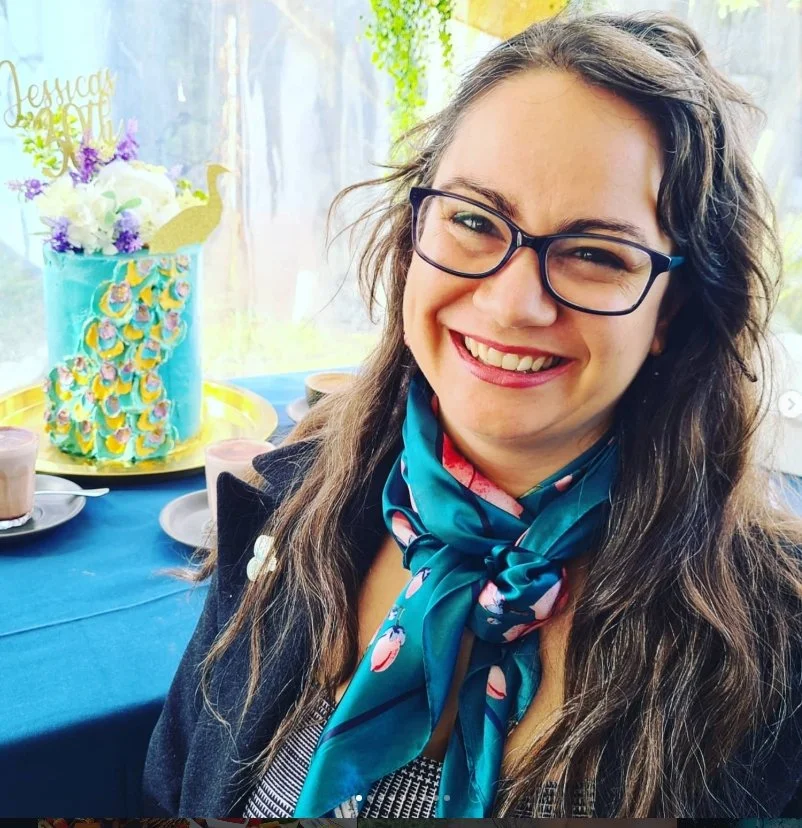
I was deeply saddened to learn of the passing of my friend, author, publisher, teacher, and seven-time StoryComic guest Amy Laurens after her battle with cancer.
Over the years of doing StoryComic, I have interviewed hundreds of writers, artists, publishers, game designers, and other creative people from around the world. Some guests come on once to talk about a particular project. Others return when they have something new to share.
And then there are people like Amy.
Amy became part of the StoryComic family.
She first joined me on Episode 53 in January 2021, and over the next several years she returned again and again. Our Friend of the Show page lists appearances on Episodes 53, 73, 93, 131, 232, and 253, and she came back once more for Episode 357 in May 2024. Seven conversations in all.
That first interview established pretty quickly why I enjoyed having Amy on the show. I wrote afterward that she had shared “a great number of tips and advice for seasoned and new writers.”
That never really changed.
Whenever Amy returned, there was usually a new book or project to discuss, but our conversations inevitably became something bigger. We talked about writing. We talked about publishing. We talked about the strange realities of trying to make a creative career work. We talked about technology, including artificial intelligence and its potential impact on authors. During one 2023 conversation, Amy also spoke about her experience with ADHD and what she had learned about adjusting her creative process to the way her own brain worked.
Amy understood something that I think many new writers take years to learn: there is no single correct way to be an author.
Her advice wasn't built around some magical formula for becoming famous. She talked about learning skills, experimenting, adapting, understanding your own strengths, and building something sustainable.
That philosophy was especially important in Amy's work as an advocate for independent publishing.
Through Inkprint Press, Amy helped demonstrate what indie publishing could actually be. It wasn't simply uploading a manuscript and hoping somebody bought it. She treated publishing as both an art and a business. Covers mattered. Formatting mattered. Distribution mattered. Understanding readers mattered. Knowing what things cost mattered.
As Amy once put it when giving advice to prospective indie authors:
“You need a good head for business or be willing to learn.”
I love that advice because it sounds like Amy.
It isn't intimidating. It doesn't say you need an MBA before you can publish a novel. It says you need to be willing to learn.
Amy certainly was.
She learned cover design. She learned formatting. She learned how different distributors worked. She learned about blurbs and marketing and production. Then, just as importantly, she shared what she learned with other writers.
Her website became a remarkable collection of resources covering everything from plotting and worldbuilding to editing, Kickstarter campaigns, publishing, writing habits, burnout, and what to do when the writing simply isn't working.
Something that means even more to me today is that Amy included our first three StoryComic interviews among those resources, writing that there “might be useful things in there for writers.”
I like knowing that.
Because those interviews were never meant to be lectures. They were conversations. But Amy understood the value in writers hearing other writers talk openly about how this strange creative life actually works.
She was also willing to talk about the parts people sometimes leave out.
Success doesn't make creativity easy.
Being productive doesn't mean you never struggle.
Being a professional doesn't mean everything suddenly works perfectly.
And sometimes the healthiest thing a creator can do is slow down.
That lesson became increasingly important in Amy's later writing. She frequently discussed the danger of tying personal worth to productivity and the pressure within indie publishing to constantly release something new.
Even while dealing with cancer and greatly reduced energy, Amy continued writing. In 2025, she celebrated completing Touchstone, her longest novel, at more than 95,000 words. But the larger reflection she shared wasn't about word counts.
It was about learning patience.
Writing about changing old habits, Amy observed that “the first step toward interrupting a pattern is to notice it.”
That is writing advice, certainly.
But it is also life advice.
One of my favorite things about talking with Amy was that she could move comfortably between those two worlds. A conversation might begin with fantasy stories, publishing schedules, magical transformations, or book covers and end somewhere much more human.
Our final StoryComic conversation, Episode 357, centered on stories of transformation. Amy discussed how magical, personal, and metaphorical transformations could reveal things about identity, relationships, resilience, and how people respond to change.
Looking back now, there is something especially meaningful about that conversation.
Amy's stories changed.
Her publishing career changed.
The tools authors used changed.
Her life changed.
But her curiosity never seemed to disappear.
Neither did her willingness to help the next writer figure things out.
Amy was also an award-winning fantasy writer whose work received recognition within Australia's speculative fiction community, including an Aurealis Award for Bones of the Sea. But I think her contribution to the indie community goes beyond any individual award or title.
She showed that independent publishing could be professional without losing its independence.
She showed that writers could learn the business without losing their love of storytelling.
She showed that sharing knowledge didn't diminish your own success.
And she showed that a creative career doesn't have to look exactly like somebody else's.
Perhaps the quote from Amy that has stayed with me the most comes from her explanation of why she chose independent publishing.
After talking about flexibility, creative control, money, marketing, and all the complications that come with running your own publishing career, Amy summed up her approach simply:
“I'm in this for the long run, not to be an overnight sensation.”
Those words carry a different weight today.
Amy was in it for the long run.
Not because a career has to last a certain number of years, but because the things we create and the things we teach other people can continue long after a conversation ends.
There are writers who know something today because Amy taught it to them.
There are readers who discovered a story because Amy wrote it.
There are authors whose books exist because Amy helped create a publishing space where those books could find readers.
And there are seven episodes of StoryComic where we get to hear Amy talk about writing, publishing, creativity, and whatever else we happened to wander into that day.
I'm grateful for every one of them.
Amy Laurens wasn't simply a repeat guest.
She was truly a Friend of the Show.
Thank you, Amy, for the stories, the laughter, the lessons, the encouragement, and the many conversations.
You will be missed.
And your stories will continue.